 عادل فيرق
Compare trekking poles by checking the length range, learning how the locks work, and testing whether the grips feel comfortable in your hands. Then consider packed length, weight and storage. An additional feature or an attractive discount does not compensate for trekking poles that you cannot adjust, check or carry conveniently on your actual outings.
Some walkers find trekking poles useful for support and a more deliberate walking rhythm, but trekking poles do not make every route appropriate for every participant. These are outdoor activity tools, not a substitute for a prescribed medical walking aid. If pain, an injury or everyday mobility is your main concern, discuss that need with an appropriate professional.
Before buying trekking poles, browse Hike & Seek’s current hiking trips and ask about the ground and required equipment. Check the information for the programme and date you are considering. The aim is to prepare for a real outing rather than accumulate items because they appear in photographs of other people’s adventures.
Start with the reason you want them
Treat trekking poles as equipment with a learning process, storage needs and maintenance instructions. If you have never used them, allow time for a calm trial in familiar surroundings. Learning a new tool at a crowded meeting point or on demanding terrain divides your attention precisely when you need it for the environment and the group.
Another participant’s enthusiasm for trekking poles can help you identify questions, but it is not proof of suitability for you. Their load, experience, height and walking preferences may differ. Ask about a specific feature, such as opening a lock or securing the trekking poles to a pack, then test that feature yourself instead of relying on a universal recommendation.
Think about when you will put trekking poles away as well as when you will hold them. You may need free hands to adjust clothing, handle belongings or follow instructions for a particular section. A practical storage arrangement prevents the trekking poles becoming something you insist on carrying in your hands regardless of the situation around you.
One staff or a pair?
You will encounter trekking poles sold as a pair and individual hiking staffs intended for their own uses. More pieces are not automatically a better purchase. Ask what the model is designed for and how the manufacturer expects it to be used. The choice also changes what you must assemble, store, cover and organise during transport.
When trying trekking poles, focus on controlled movement rather than speed. With a pair, notice whether you can coordinate your hands without interrupting your stride or occupying other people’s space. An individual staff feels different and should be evaluated on its intended terms. Do not turn a first trial into a performance that distracts from the practical decision.
A photograph of trekking poles beside a dramatic rock formation does not tell you whether you can use that particular model comfortably. Your questions are simpler: have you tried it, does it match your size, and can you manage it when it is packed? If those answers are unclear, you need information before accessories, upgrades or a purchase deadline.
Get the length question clear
For trekking poles, start with the manufacturer’s sizing guidance for the exact model. Fixed lengths and adjustable ranges require different checks. REI describes an approximately right-angled elbow on level ground as an initial fitting reference; that is a starting point for understanding adjustment, rather than a personal prescription covering every walker and terrain change.
Ask where the extension limits are marked on trekking poles and how to read them. Do not extend a section beyond its permitted range and assume that tightening the lock will compensate. Knowing the difference between a measurement marking and a limit marking is part of owning the product, not a detail to investigate while everyone else waits on a trail.
A usable range matters
Check that adjustable trekking poles cover your required length inside the stated operating range. Avoid a fit that depends on an unclear limit or an improvised extension. If another family member will use the trekking poles, repeat the fitting for that person. Shared ownership does not mean shared settings, and a different colour does not reliably identify the correct size.
Test with realistic equipment
Try trekking poles with footwear similar to what you will actually wear and, where the shop allows it, a representative pack. Stand and walk a few calm steps. Notice your shoulder position and whether the grip feels natural. A model that looks convenient on a display may feel different once your hands and body are moving together.
Choose a lock you understand
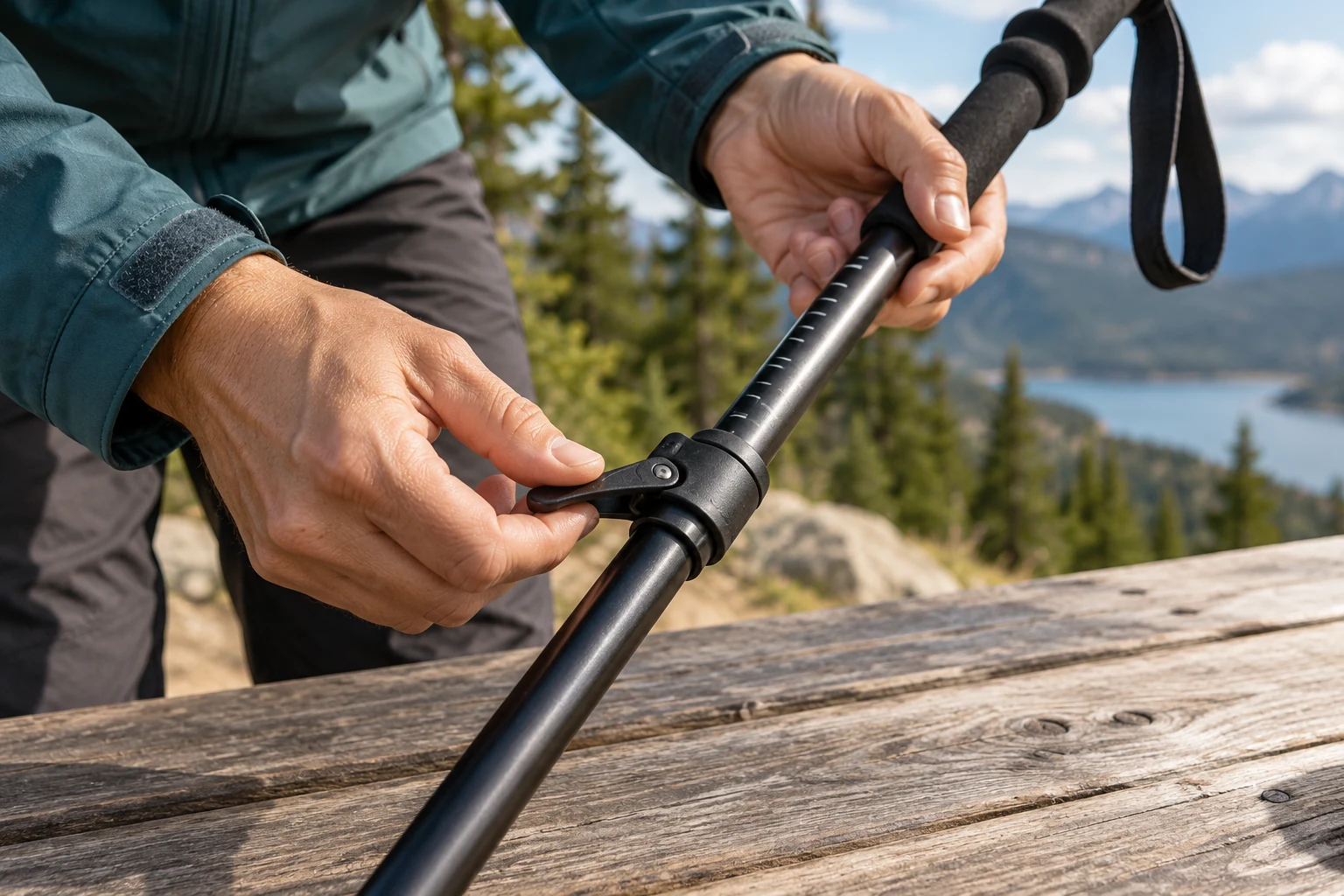
On adjustable trekking poles, the lock holds the sections at the selected length. Designs vary, including external levers, twist mechanisms and buttons. You do not need to memorise every category name, but you do need to know how your chosen model opens, closes and is checked. Ask what confirms correct engagement according to its actual instructions.
Operate the locks on trekking poles yourself after the demonstration. Watching a salesperson do it is different from repeating the process confidently. If you expect to wear gloves, check whether the relevant controls remain manageable in a safe trial. A useful demonstration ends with you understanding the mechanism rather than simply believing that someone else understands it.
Do not test trekking poles by hanging your body weight from them or improvising a dramatic strength demonstration. Follow the manufacturer’s checking procedure. If sections move unexpectedly, stop and investigate. This equipment is not a climbing anchor, a safety rope or a device for securing someone at an edge, and the trial should not imply otherwise.
A comparison table for mechanisms
| Feature | Useful question | Reason to reconsider |
|---|---|---|
| Fixed length | Does this exact size suit the intended user? | You have judged the shape without checking the fit |
| Adjustable length | Is your setting inside the stated operating range? | You would need to pass an extension limit |
| External lever | Can you engage and check it as instructed? | Unexpected movement remains after correct adjustment |
| Twist system | Do you understand the specified operation? | You rely on excessive force or guesswork |
| Folding construction | Can you assemble and secure every section? | A connection remains unclear or incompletely engaged |
Grips and wrist straps
Hold trekking poles long enough to notice grip size and shape rather than merely the colour or advertised material. Your hand may feel more comfortable on one model than another, and gloves can change the comparison. Look for a usable fit without a persistent pressure point. A more expensive material does not automatically provide the better personal match.
Wrist straps on trekking poles can differ in direction, adjustment and intended operation. Read the relevant instructions and ask for a demonstration from someone qualified to explain the trekking poles. Understand when your hand needs to be released for a particular situation. A technique seen in a short video should not override product guidance or the instructions for the actual route.
If you are comparing trekking poles for several users, do not dismiss grip size and strap adjustment as cosmetic differences. Practise holding, releasing and organising the trekking poles calmly. An unresolved basic step is worth clarifying before an outdoor trial. A simpler model that you understand can be more useful than extra functions that remain confusing when you need them.
Weight and packed length are separate decisions
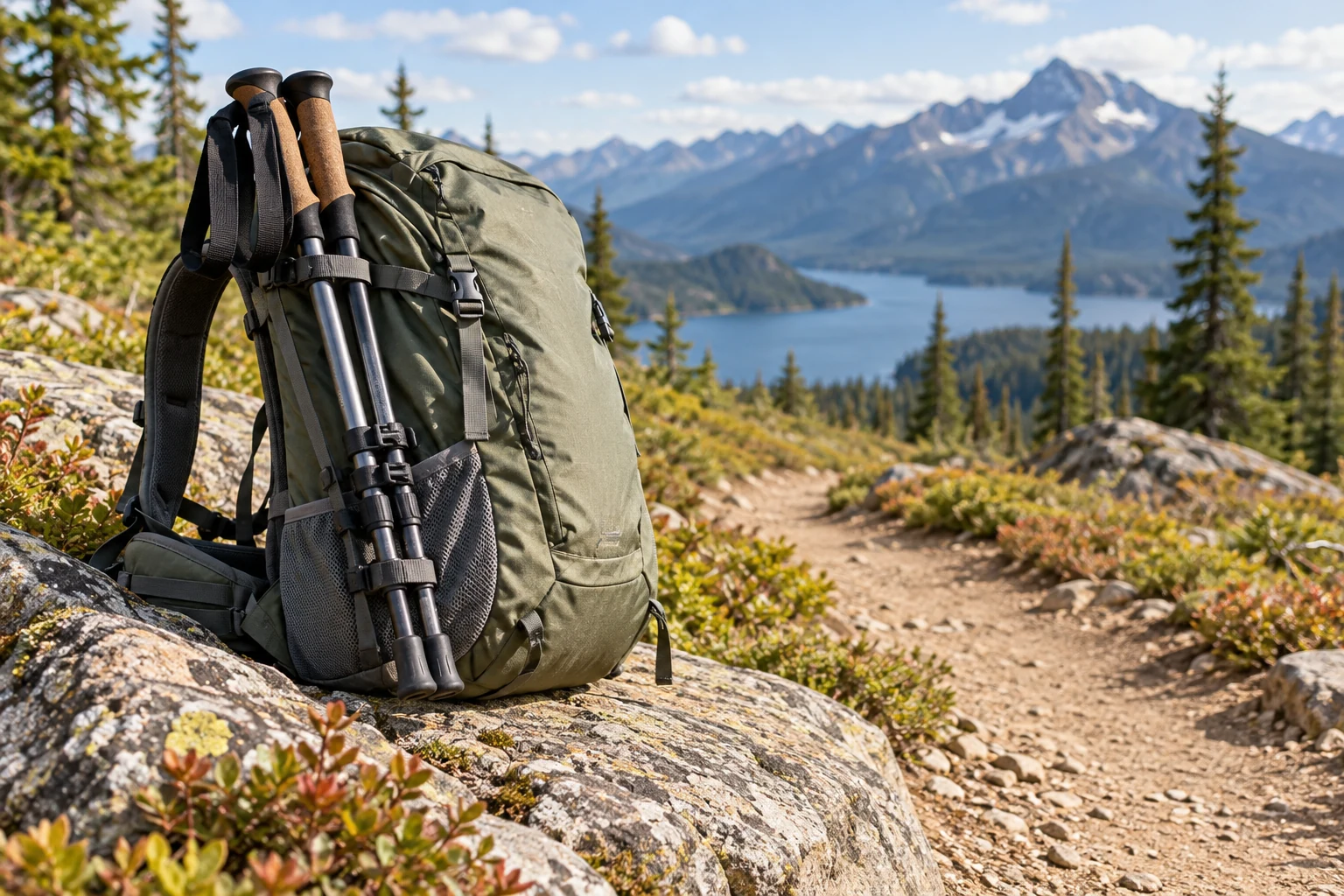
The weight of trekking poles matters in use, while packed length matters when they become part of your luggage. Compare them beside the daypack you actually intend to carry. Identify the pack’s suitable attachment points and check whether the trekking poles can be secured without loose movement or an awkward projection. Marketing photographs cannot establish that match for your own belongings.
Do not judge packed trekking poles from a picture showing a different bag. Compare the stated dimensions with your storage space and ask which covers or compatible accessories are included. The aim is not to buy every attachment. It is to avoid arriving with trekking poles that do not fit your transport arrangement or cannot be secured sensibly during the journey.
Compare materials in context
The material used in trekking poles contributes to a trade-off involving weight, cost, inspection and care. Do not turn one material name into a universal durability claim. Read the specifications and service guidance for the exact product. Compare the stated weight of an individual piece with an individual piece, or a pair with a pair, so the numbers describe equivalent items.
Ask what an extra feature does
Some trekking poles include additional mechanisms or accessories. Ask what the feature changes, how it works and whether that change addresses something you need. If you cannot explain its benefit in plain language, avoid making it the main reason for paying more. Fit, straightforward operation and the ability to check the trekking poles remain more fundamental ownership questions.
Learn the routine before the group outing
Start using trekking poles in an appropriate familiar place where you can concentrate on the trekking poles without obstructing other people. Practise setting the length and changing between use and storage. You are not trying to master advanced movement in one session. You are learning enough that the tool does not demand all your attention during the planned trip.
During a first trial with trekking poles, include ordinary interruptions. Stop, arrange the trekking poles without blocking the path, and practise securing it to your pack. These routines seem minor at home, but they affect the group’s comfort if you need a prolonged explanation whenever you take a break. Preparation includes transitions, not only the moments when you are moving forward.
If trekking poles consistently cause confusion or discomfort, reassess before the departure date. Review the setup with the retailer and check the route requirements with the organiser. Buying a different tool is not a substitute for appropriate advice about pain or a health concern. Do not assume that enthusiasm on the day will solve an unresolved operating or suitability problem.
Questions for Hike & Seek
Ask whether the chosen programme has specific guidance about trekking poles and which equipment participants must bring. Do not assume that rental, free provision or specialist instruction is included unless the current listing or team confirms it. A clear enquiry about the exact trip prevents both an unnecessary purchase and an arrival with missing equipment.
If this will be your first outing with trekking poles, mention it when discussing preparation. Ask about luggage arrangements and any transport restrictions affecting longer items. The purpose is to coordinate expectations, not to ask the organiser to prescribe a product or assess a medical need. Contact Hike & Seek for programme details before buying equipment to fill an information gap.
Consider other people while moving and stopping
Be aware of the tips of trekking poles when turning or looking back. Before taking a photograph, stop in an appropriate place and organise the trekking poles before concentrating on your phone. Do not swing it to point near someone else’s face. Respect for shared space is part of using outdoor tools, just as checking a lock is part of preparing them.
During a break, place trekking poles where they do not obstruct movement or leave a projecting tip in someone’s path. Follow the leader’s directions about the stop and check the trekking poles again before continuing. If the situation calls for free hands or a different arrangement, prioritise that instruction over a habit of keeping the trekking poles in your hands throughout the entire outing.
A routine for the day
| Stage | Action | What you establish |
|---|---|---|
| Before leaving | Check length, locks and visible condition | No obvious issue or unexplained operating step remains |
| Packing | Test attachment and suitable tip coverage | No unsecured equipment swings against other belongings |
| Meeting point | Confirm loading and group instructions | Equipment does not obstruct boarding or luggage organisation |
| Rest stop | Store it appropriately and recheck before use | Others have clear space and you understand the current setup |
| After returning | Clean, dry and record useful observations | You can address a problem before another outing |
An illustrative comparison
Imagine a participant choosing trekking poles who mainly needs a convenient fit with a daily hiking bag. The shortlist includes a fixed model and an adjustable one. First the participant checks the actual fitting, then the packed dimensions. After a lock demonstration, they repeat the operation themselves. This compares real ownership tasks rather than two colours or a brand reputation.
In this hypothetical example, one pair of trekking poles fits the luggage arrangement but has a connection the participant does not yet understand. They ask for another explanation instead of buying solely because the product is light. If the uncertainty remains, a simpler alternative stays relevant. This is a decision example, not a customer story or a product endorsement.
Care and inspection between trips
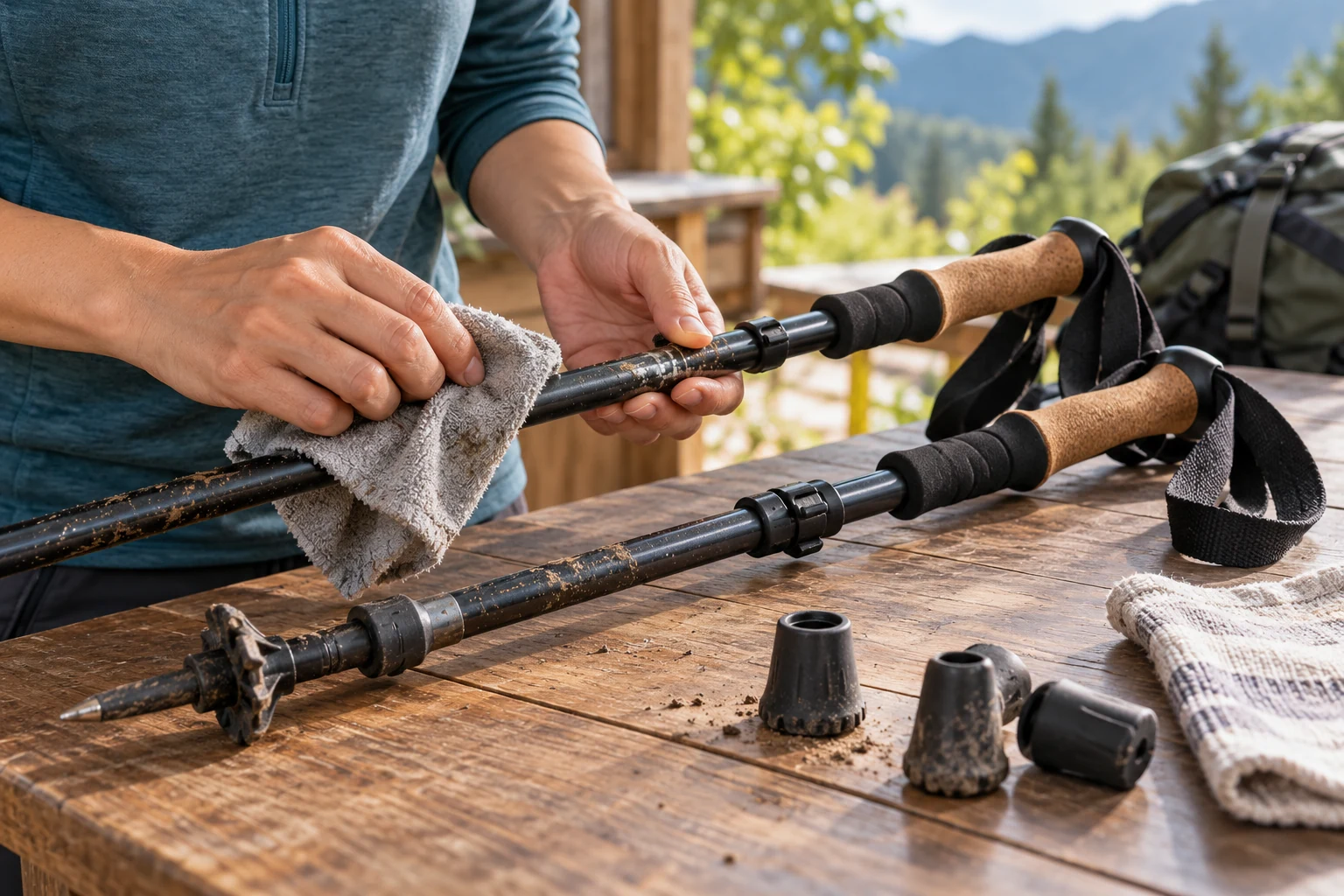
Follow the instructions for your trekking poles when cleaning, disassembling or storing them. Designs do not all permit the same dismantling process, cleaning products or adjustment methods. When the documentation is unclear, ask the manufacturer or retailer before experimenting. Responsible maintenance begins with understanding what the product allows, rather than borrowing a procedure intended for something with a different construction.
Inspect trekking poles for visible changes in alignment, grips, tips and locking components, using the product’s service guidance. Do not take questionable trekking poles onto a remote route to discover whether it still works. Tape or extra tightening is not a universal answer to an unexplained fault. The appropriate next step may be a service enquiry instead of another improvised outdoor test.
After cleaning and drying trekking poles as instructed, store them without pressure against other equipment or exposure that conflicts with the manual. Retain the model information and relevant purchase details for a service enquiry. There is no single replacement age that applies to every construction and history of use. Their actual condition deserves attention before the next planned activity.
Borrowing, buying and setting a budget
Borrowing trekking poles can be a useful way to discover preferences when their condition, instructions and ownership arrangements are clear. Check the size and repeat the setup for yourself rather than accepting the previous user’s settings. Agree how they should be returned. Borrowing may postpone a rushed purchase, but it does not remove your responsibility to understand and look after the trekking poles.
Set a budget for trekking poles around your expected use and what is included, without relying on an invented price range. Compare written warranty and return terms as well as the contents of the box. A modest price difference does not settle a comparison when the alternatives differ in ease of operation, essential accessories, service or the clarity of their instructions.
Keep the product identification and its written instructions somewhere you can find them after discarding the packaging. If an accessory needs replacing, check compatibility with the exact model before ordering. Similar names or appearances do not prove that a spare part fits, and a clear written service enquiry is better than an improvised repair.
A decision table before payment
| Priority | Evidence you can look for | Reason to postpone |
|---|---|---|
| Fit | A suitable length and comfortable grip for the actual user | You are accepting a size or pressure problem |
| Operation | You can open, engage and check the relevant mechanism | You still depend entirely on someone else doing it |
| Transport | Packed dimensions and attachment suit your luggage | Equipment projects awkwardly or conflicts with transport guidance |
| Support | A manual and clear written purchase terms | The decision relies on an unclear verbal promise |
| Need | Features relate to an identifiable use | The name of an extra function is its only attraction |
Frequently asked questions
Should I choose one staff or a pair?
Compare trekking poles and an individual staff according to their design and the use you are learning. Ask for a practical explanation and try calm movement and storage. If the programme has relevant requirements, establish those before purchasing. There is no single choice determined by the number of pieces alone, and another person’s preference does not establish your own.
How do I choose the length?
Start with the sizing guidance for the exact trekking poles, then try the setup on level ground with suitable footwear. A near right angle at the elbow is an initial general reference, not an individual assessment for every situation. Stay inside the manufacturer’s extension limits and ask for a demonstration when a marking or adjustment step is unclear.
Does folding always mean adjustable?
No. Folding trekking poles for storage and changing their usable length are different functions. Read the specific model’s description and check the actual size and assembly method. A fixed-length construction does not gain a safe adjustment range simply because its sections can fold or disconnect. Do not create a setting that the product documentation does not describe.
Can they replace a medical walking aid?
Do not treat trekking poles as an automatic replacement for an individually prescribed mobility aid. Pain, rehabilitation and everyday balance needs deserve appropriate professional advice. This guide discusses outdoor equipment comparison and preparation. It does not assess a health condition, provide treatment or guarantee that a tool prevents an injury or makes a particular route suitable for someone.
Are they included in a trip booking?
Do not assume trekking poles are supplied or available to rent through Hike & Seek without current confirmation. Review the programme and ask what participants must bring. That makes your preparation specific to the real booking rather than an assumption based on another outing. This article does not advertise an equipment service that the team has not confirmed.
How should I manage them during a break?
Secure trekking poles using an appropriate arrangement for your pack or place them as directed by the leader, clear of other people’s movement. Practise the transition before departure. Holding the equipment during photography or boarding is not the only option, and a projecting tip should not become someone else’s problem simply because you have not planned a storage routine.
When should I stop relying on a piece I own?
If trekking poles show unexpected slipping or an unexplained change in a component, stop relying on them until you consult the instructions and relevant service support. A photograph or a brief general article cannot certify an individual item’s condition. Another improvised trial away from help is not a substitute for understanding the fault and the manufacturer’s recommended response.
What should I do after choosing a model?
Give trekking poles a calm trial in familiar surroundings and read the instructions before your main outing. Practise setup and storage, note any unresolved step and clarify the group’s requirements. If you still need repeated help with a basic operation, address that before the meeting point instead of expecting the equipment to become self-explanatory during a new experience.
Prepare around a clear trip plan
Choose trekking poles after understanding the outing, then learn how to adjust, check and carry them before departure. Explore Hike & Seek’s current hiking programmes and contact the team about the ground, duration and participant requirements. With that information, your equipment decision becomes part of a realistic preparation plan rather than a separate shopping exercise.