 عادل فيرق
Begin waterproof packing by identifying what must stay dry, possible sources of moisture and the documented limits of the containers you own. A cover over a backpack does not establish identical protection for a phone, spare clothing and sleeping equipment. Separate contents by sensitivity and access needs, read each closure’s instructions and practise the complete arrangement at home. You do not need to expose valuable electronics to water or perform an unapproved immersion test to discover that a bag is overfilled or awkward to use.
This is a waterproof packing planning guide for transport, walking and camping, not a guarantee against water in every situation or instructions for crossing floodwater. Moisture may come from a leaking bottle, used clothing or external exposure. Different causes require different decisions. Equipment does not make an unsuitable programme or prohibited activity appropriate. If the location’s instructions or conditions prevent participation, an additional bag does not change that decision. Protection products help only within their own intended uses and documented limitations.
Before waterproof packing for Hike & Seek, review the published hiking trips and Contact Hike & Seek about the selected programme and luggage requirements. Ask about carrying and transport without assuming a dry store, additional luggage space or protective containers are included. Then ask the supplier about the products you intend to use. The organiser’s information describes the activity; the manufacturer explains the equipment. A confirmed place on transport is not a promise that every item receives a particular level of water protection.
Map your contents before choosing waterproof packing equipment
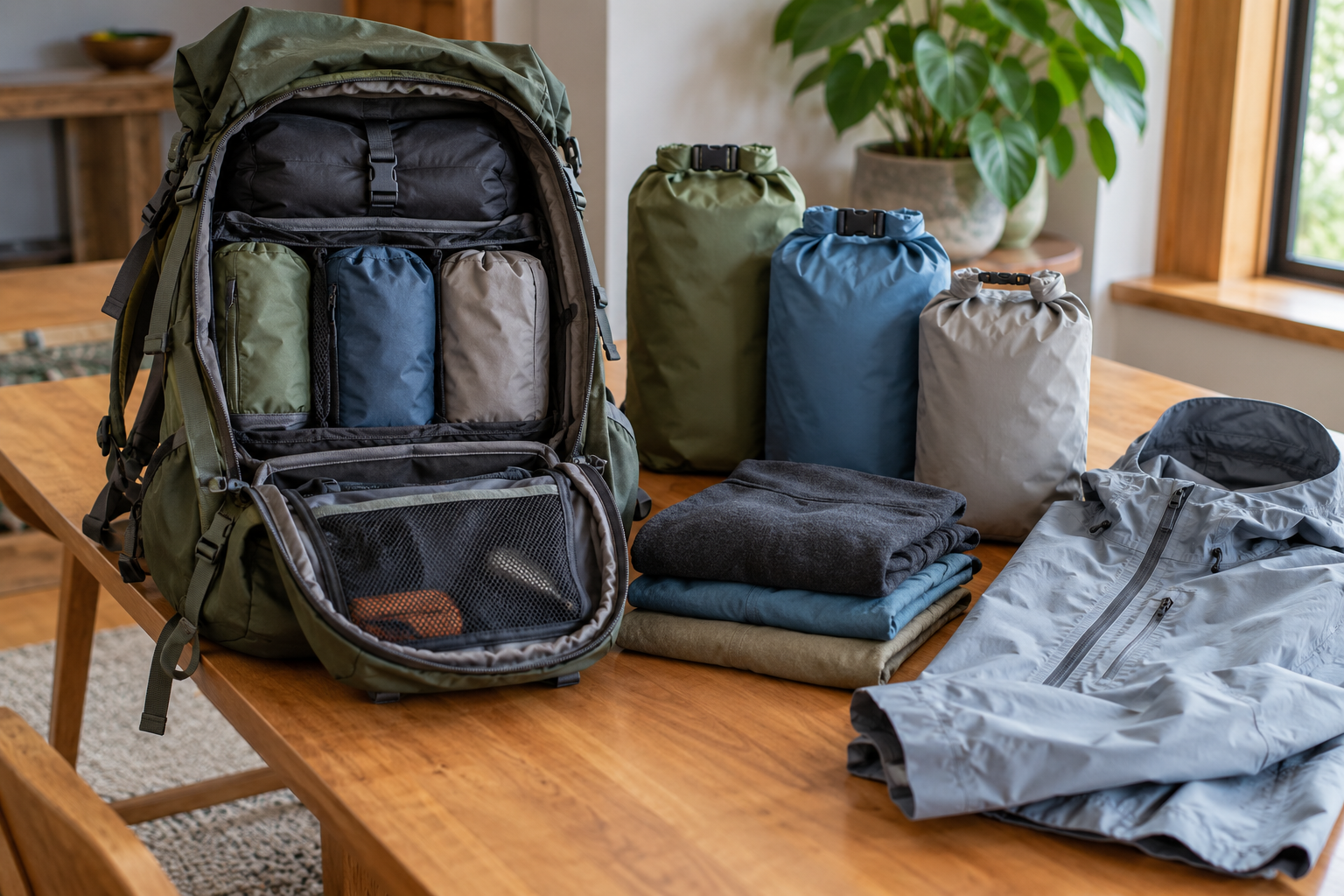
Lay out spare clothing, sleeping equipment, electronics, documents, food and frequently used tools. Each group need not receive identical layers. Connect waterproof packing to the item’s function and consequences of getting wet, then choose its container and position. Used clothing needs separation, a bottle needs a sound closure and an item required during a short stop needs practical access. A system that forces you to unpack everything repeatedly can undermine organisation even when individual containers are suitable for their intended purpose.
Priorities change with duration. Keeping sleeping equipment dry may be central to an overnight arrangement, while a day trip may place different emphasis on documents, electronics and replacement clothing. Do not copy another person’s waterproof packing list without understanding their equipment and programme. Record why each group exists. Check whether the waterproof packing container is genuinely appropriate or simply the largest spare sack available. Physical capacity alone does not establish protection, intended use or whether you can perform the required closure correctly after loading it.
Identify the moisture source before choosing waterproof packing
Distinguish internal leakage, contact with damp belongings and external exposure. That makes waterproof packing more precise. A rain cover does not repair a damaged bottle cap. Separating wet clothing does not establish that a phone is protected from immersion. Avoid assigning one product to unrelated problems. Review internal closures, separation and external protection together, and retain the information showing what each item can do. An attractive product name should not become a guarantee that the documentation does not actually provide.
Read the actual waterproof packing product specification
Separate a short advertising phrase from detailed use instructions. For waterproof packing, read the permitted exposure, closure process and any restrictions involving electronics, pressure or immersion. Do not transfer a specification from another product with a similar name. Protection may differ between fabric, openings, zips and accessories. Thick material or droplets in a promotional photograph cannot establish a capability. Ask for the model’s documentation where an important decision depends on a claim that is not explained in the listing or packaging.
Sea to Summit‘s dry-bag closure guidance identifies limitations relevant to sensitive contents. Use that principle to read your own product’s documentation rather than treating one manufacturer’s explanation as a universal guarantee. Send the supplier the full model name and intended waterproof packing use when a question remains. Do not resolve an ambiguous waterproof description by putting a phone into a bag of water. The experiment may exceed intended use and expose equipment to a loss that a clear question could have prevented.
| Waterproof packing question | Evidence required | Insufficient evidence |
|---|---|---|
| Will it suit the intended exposure | Model-specific use limits | A resistant label alone |
| How does it close | Roll-top or zip instructions | Copying another bag |
| Can it hold sensitive electronics | An appropriate documented recommendation | The phone physically fits |
| Will the system remain practical | Loaded access and carrying trial | Appearance when empty |
| How is it maintained | Inspection cleaning and storage instructions | A generally rugged appearance |
Understand the backpack cover’s role in waterproof packing
Check the cover’s size, attachment and any exposed areas, then protect sensitive contents internally as appropriate. A correct cover may perform its stated function without proving that every item remains dry in every circumstance. Waterproof packing should not block essential access or interfere with carrying the backpack. Open the relevant pockets and refit the cover at home. Reaching one small item should not require dismantling the waterproof packing arrangement or placing the entire load on an unsuitable surface during a brief group stop.
Where the waterproof packing product requires a liner or accessory, confirm compatibility rather than choosing a similarly sized item. An extra layer is not automatically an improvement if it prevents closure or complicates normal handling. Evaluate waterproof packing after loading. Check pressure around sensitive items and space near openings and carrying points. A small added object can change how equipment sits. Read the relevant instructions rather than relying on an orderly photograph of empty containers laid beside a bag that has never held the complete trip load.
Learn the roll-top closure for that product
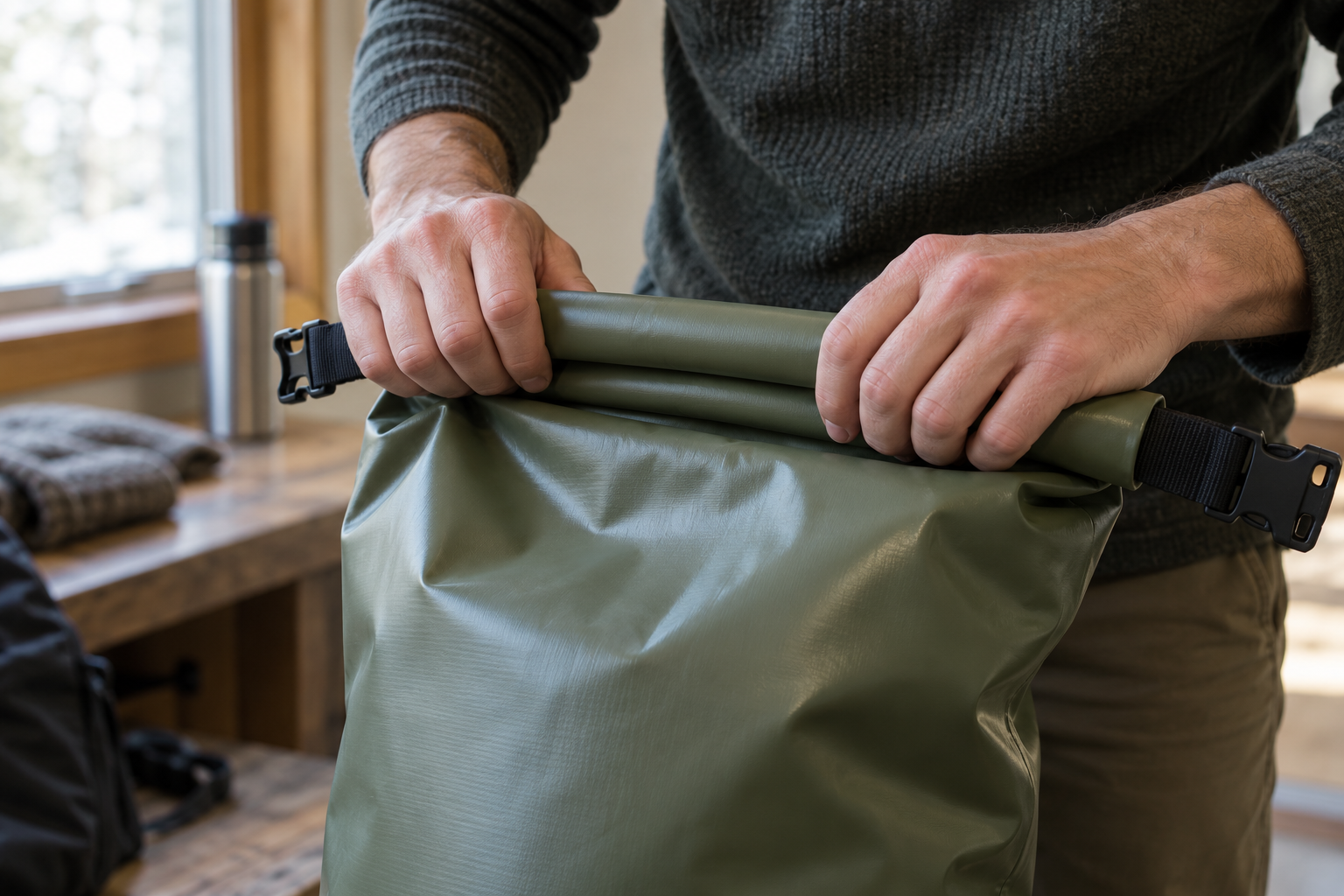
Follow the manufacturer’s alignment, air-release, rolling and fastening process, leaving the required closing space. There is no universal number of rolls for every container. Waterproof packing includes avoiding loads that prevent correct closure. Practise with non-sensitive contents and do not force a buckle to compensate for overfilling. If the process cannot be completed as instructed, reduce the waterproof packing load or choose an appropriate size. A fastened clip does not prove that the preceding steps were performed correctly or that the intended seal was achieved.
Inspect and clean closing surfaces as instructed before use. A small trapped object or piece of fabric can interfere with the required sequence. Do not rely on memories from an older model where the design differs. Ask for a demonstration, perform it yourself, then repeat after opening and repacking. Reliable waterproof packing requires a method you can reproduce with actual contents, not simply a closure the salesperson demonstrated on an empty bag while you watched without learning the alignment and available space.
Check roll-top limits during waterproof packing
A roll-top opening does not establish that its contents can be submerged or that electronics are protected under any exposure. Read the exceptions instead of inventing a rating. Waterproof packing for expensive sensitive equipment needs documentation matching the actual use. Specialist activities require appropriate preparation beyond this article. Two arbitrary bags do not create a new guarantee merely because they fit inside each other. Follow the particular products’ intended use and relevant guidance rather than combining separate claims into an unsupported level of protection.
Divide the waterproof packing load into understood units
Give each unit a function or known access time without creating dozens of unidentified bags. Spare clothes, sleeping equipment and small tools can be separated while retaining clear return positions after use. Waterproof packing should not depend on colour alone when others may carry or rearrange the waterproof packing load. Explain the groups or use an appropriate identifier that does not expose unnecessary personal information. The objective is understanding the contents and sequence, rather than adding labels and compartments whose purpose nobody else knows.
Calculate weight and volume after adding protection. Too many containers can prevent the main bag closing or bury an essential item. Test waterproof packing through actual use: can you find the required clothing without removing everything, and can the opened unit return to its place? Good organisation combines documented product limits with practical access. Neither the largest number of bags nor the fewest is automatically correct. Keep separation that solves a real problem and remove duplication that adds weight without an identified protective or organisational purpose.
Separate damp contents during the trip
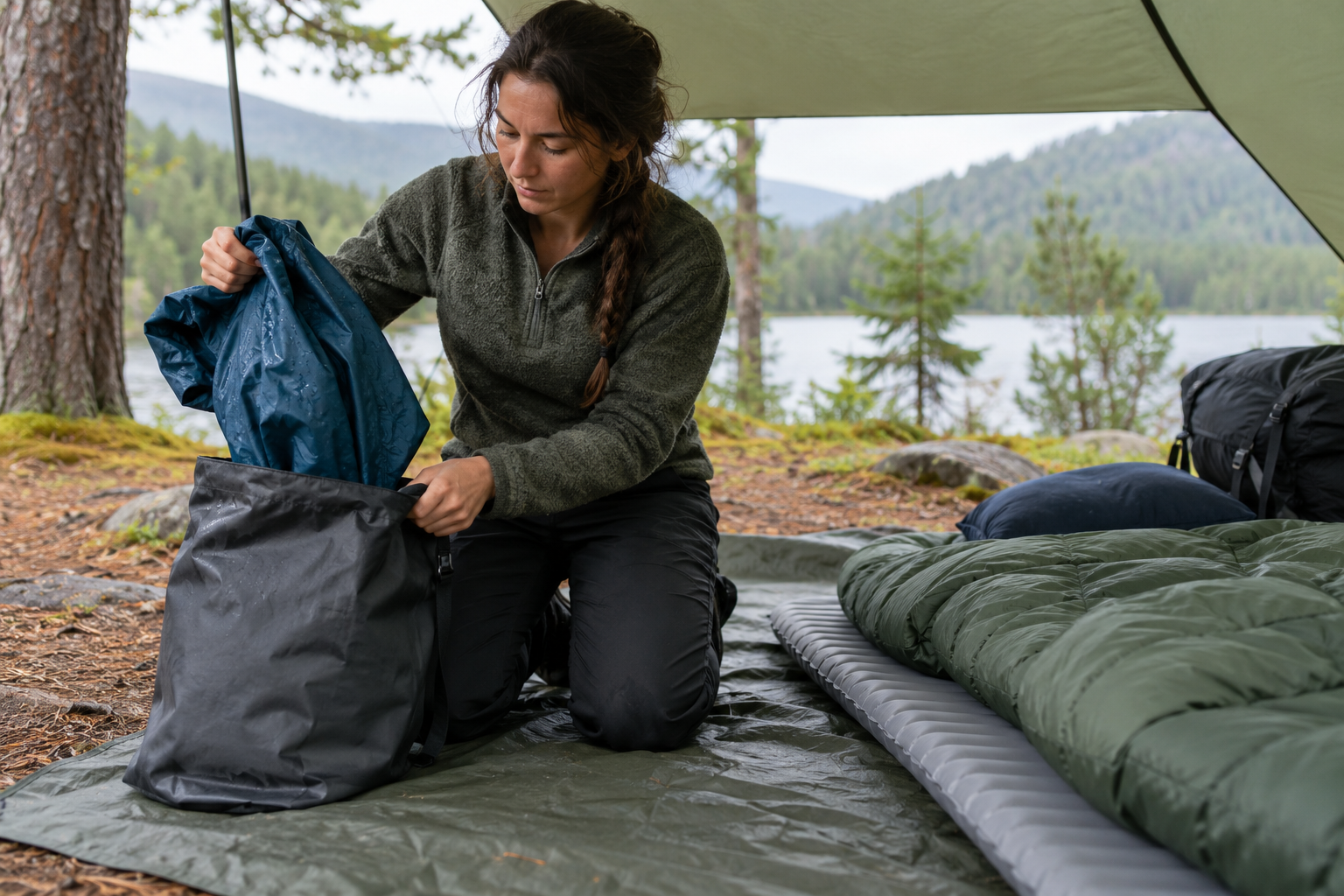
Allocate a place for damp clothing and equipment so that they do not contact items intended to remain dry. Waterproof packing changes after the first clothing replacement or towel use; it does not finish when you leave home. Choose a suitable temporary separation container and understand how to empty, clean and dry it afterwards. Transporting a damp item temporarily does not authorise prolonged sealed storage. Do not reuse a dirty equipment container for food or electronics without checking its suitability and required care.
At a stop, place belongings on a suitable clean permitted surface and avoid random movement between units. Organised waterproof packing lets you track what has left, returned or needs separation. Coordinate genuine repacking needs rather than leaving open bags and scattered items while attempting to catch up with the group. At home, revise a system that requires complete unloading at every access. Protection should work with ordinary use throughout the day, not only with the carefully arranged initial load before anyone needs something from inside it.
| Contents group | Organisation | Review during use |
|---|---|---|
| Replacement clothes | A separate understood unit | Keep away from used clothing |
| Sleeping equipment | Position for the overnight schedule | Avoid unnecessary opening |
| Frequently used tools | Practical access | Do not require emptying the pack |
| Damp belongings | Suitable temporary separation | Empty and dry after returning |
| Liquid containers | Checked closure and placement | Prevent leakage towards sensitive units |
For programme-specific waterproof packing questions, contact the team about luggage, transport and activities. Do not ask the organiser to certify equipment they have not assessed, or treat vehicle space as a guarantee of protection. After understanding the programme, review products with the supplier. Keep meeting and contact information accessible without opening the complete load. Your list should follow confirmed arrangements rather than assuming that extra storage, a protective case or another participant’s equipment will become available after arrival without prior agreement.
Give electronics appropriate documented protection
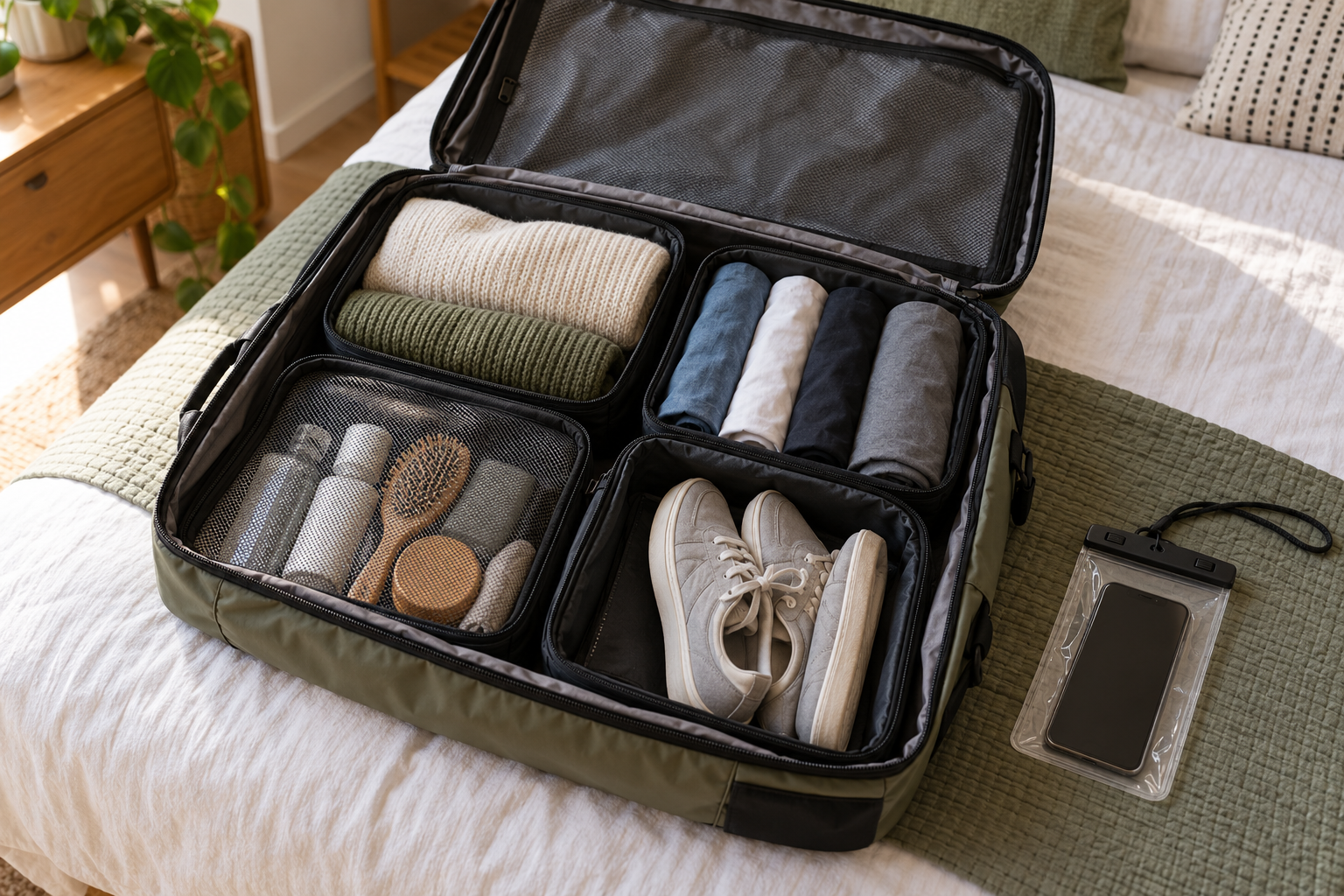
Read the device and case instructions together. Do not combine separate statements to create a stronger promise, or assume a clothing sack substitutes for an electronics case. Waterproof packing of sensitive equipment may require a product intended for that purpose within specific limits. Understand closure, access and carrying without testing on valuable contents. Consider the device’s current condition too. A statement concerning a new product may not apply in the same way after damage, repair or the addition of accessories whose compatibility you have not checked.
Plan phone access without unnecessarily opening other contents. Keep essential trip information available in an appropriate form and do not assume connectivity everywhere. This article does not guarantee communications or provide a rescue procedure; its waterproof packing role concerns organisation and containers. Ask the organiser about any programme communication requirements. Check compatible power accessories rather than carrying equipment you have never tried or relying on an unspecified participant to produce the right cable or charger when your own device needs it during the journey.
Inspect liquids inside the waterproof packing bag
Moisture can originate inside the load. Review caps, connections, orientation and transport instructions. Do not overlook a water bottle in waterproof packing or use an external wrapping to compensate for a known defective closure. Resolve the cause or choose a suitable replacement before travel. Moving clothes slightly farther away does not repair leakage. Check the waterproof packing container under ordinary loading conditions: pressure and position inside a full bag may differ from a bottle standing upright by itself on a table during a brief inspection.
Maintain appropriate separation for food and keep suitable containers clean. Waterproof packing does not remove food-handling considerations simply because everything is enclosed. Practise accessing and closing bottles by hand. An item may seal correctly but be so awkward that a user leaves it open. A home trial identifies those difficulties before departure. The objective is not proving an undeclared water-resistance claim; it is confirming that ordinary repeated use can follow instructions without shortcuts that interfere with closure or mix dirty and clean belongings.
Conduct a safe waterproof packing trial
Load the complete contents, open them as you would during the trip and repack. Checking waterproof packing does not require unapproved spraying or immersion. You can identify excessive filling, poor access and missing accessories without water. If the manufacturer describes a specific test, follow its conditions with appropriate non-sensitive test contents. Request clarification where needed. Do not turn inspection into a challenge that risks possessions to demonstrate a capability the supplier or documentation never offered for the waterproof packing product in the first place.
Carry the bag as instructed and review balance and pressure. Does a hard object press against something sensitive? Can you close each unit without forcing it? Waterproof packing depends on repeating the arrangement after use, not one successful initial setup. Explain the waterproof packing system to anyone sharing the load and choose a specific correction if a problem appears. Doubling every container automatically may miss the cause. A changed bottle position, less filling or a suitable replacement closure can be the relevant improvement.
Clean dry and inspect after returning
Empty containers, inspect them and follow their cleaning, drying and storage instructions. Successful waterproof packing on one day is not a reason to leave everything sealed until the next trip. Review closing edges, caps and small components, keeping accessories together. Seek supplier guidance about unexplained deterioration before relying on the waterproof packing product again. An additional wrapping is not an approved repair merely because it conceals the damage, especially where protective performance depends on a missing or damaged part of the closure system.
Record what changed during the trip: an inaccessible item, a unit too small after use or damp clothing requiring more separation space. Base the next waterproof packing arrangement on those observations and the new programme. Do not generalise a short dry trial to different conditions or replace inspection with the statement that it worked previously. Contents, duration and transport can change. A system adequate for one outing may need revision when overnight equipment or an unfamiliar device is added to a load that has never carried it before.
A hypothetical overnight packing example
Imagine a participant placing clothing, a phone and a water bottle in one compartment, then buying a rain cover. A loaded trial reveals a leaking bottle and difficult access to spare clothes. They review the closure, separation and an appropriate device case. This is a hypothetical example, not a Hike & Seek test or guarantee. It shows how waterproof packing begins with contents and moisture sources, then selects suitable documented solutions. An external layer does not automatically resolve an internal leakage problem that it was never intended to address.
| Problem in the example | Intended correction | What the result does not establish |
|---|---|---|
| Internal leakage | Resolve the bottle and closure | A rain cover solves every moisture source |
| Difficult access | Arrange units by actual use | More bags are always better |
| Phone in a clothing sack | Read a suitable case specification | Any roll-top suits immersion |
| Used clothes beside dry items | Separate then clean and dry | Long-term damp sealed storage is appropriate |
| Overfilled container | Allow correct closing space | The buckle alone proves protection |
Frequently asked questions about waterproof packing
Is a rain cover enough for waterproof packing?
Read its function, limits and size, then arrange sensitive contents internally as appropriate. Waterproof packing does not automatically depend on one layer. Moisture can arise internally, during opening or through contact with used belongings. A cover does not establish immersion suitability or repair a damaged bottle closure. Use it as instructed within an understood system. Review each moisture source rather than expecting the same solution to answer unrelated problems beyond the product’s stated function and design.
Are all dry bags equivalent for waterproof packing?
Read the waterproof packing product design, use limits and recommended contents. Waterproof packing requires the actual model rather than the category name alone. Materials, closures, permitted exposure and suitable sizes can differ. Another person’s success with similar equipment does not guarantee yours. Request the documentation or an explanation where an important point is unclear. An appropriate product is one whose instructions you can follow in your intended use, rather than a label whose meaning you have expanded without supporting information.
How do I close a roll-top for waterproof packing?
Follow the particular manufacturer’s sequence and required space instead of one universal number. Waterproof packing includes alignment, rolling and fastening according to that model’s instructions. Do not force contents into a closure that can only be fastened superficially or leave fabric trapped in the opening. Review size and quantity if the process cannot be completed. Ask for a demonstration. A method learned on another bag does not establish the correct procedure for every similar-looking construction or accessory.
Does waterproof packing for clothing also protect my phone?
Do not assume that provides the protection required. Read the device and container instructions and choose a documented solution for the actual exposure. Waterproof packing of electronics is not established by physical fit or a buckle. Avoid testing with a valuable phone or performing an unapproved immersion experiment. Where documentation excludes sensitive equipment or your intended use, find an appropriate alternative rather than adding an arbitrary layer and assuming the exception no longer matters to the combined arrangement.
How should waterproof packing separate damp clothing?
Use a suitable temporary container, then empty, clean and dry it as instructed after returning. Waterproof packing does not mean storing damp clothing sealed indefinitely. Check the space after actual use, when items may be less compact or harder to fold. Give the unit an understood position. Do not reuse a dirty container for food or sensitive electronics without checking suitability and care. Separation supports transport; it does not replace appropriate drying, cleaning and storage once the journey has finished.
Does waterproof packing require many individual bags?
Choose a number that supports separation and access without unnecessary complexity. Assess waterproof packing by correct closure, finding items and returning them, rather than layer count alone. Try the complete load and review weight and volume. A few clear units may suffice; particular equipment may need additional documented protection. Remove duplication without removing essential separation. Avoid a system so complicated that users abandon its steps after the first stop because repacking correctly takes more time and space than the programme allows.
Does Hike & Seek provide waterproof packing equipment?
This guide does not assume they are included in every programme. Read the description and ask about booking inclusions and luggage requirements, then arrange your personal waterproof packing and check product specifications with the supplier. Vehicle space does not establish a sealed store or a dryness guarantee. Identify the programme, date and transport arrangement so that the answer supports a practical list. Photographs of another departure or an informal participant’s promise do not establish the equipment provided with your actual booking.
What should I check before reusing waterproof packing equipment?
Inspect closures, caps, accessories, condition, cleanliness and dryness according to the instructions. Confirm suitability for the current contents. Do not base waterproof packing solely on a memory of previous success. Review duration, activity and transport and repeat the loaded access trial where the list changes. Resolve missing or damaged parts with the supplier or choose an appropriate replacement before travel. Concealing a defect under an unapproved layer does not establish that the waterproof packing product has returned to its intended condition or protective performance.
Agree where a removed closure or cap returns after use. Keeping related components together prevents a necessary part travelling separately when bags are divided between people or vehicles.
Confirm the waterproof packing arrangement before departure
Review contents groups, moisture sources, product limits, closures and access, then Contact Hike & Seek about the selected programme’s requirements. Retain model instructions and make waterproof packing a process you can repeat after every use. Knowing each item’s position, separating damp belongings and checking bottles reduce organisational surprises. Equipment limits and site instructions still guide the decision. A neatly packed photograph does not replace checking the actual conditions during use, maintaining the products afterwards or reconsidering the waterproof packing arrangement when a different activity changes what you need to carry.